 By
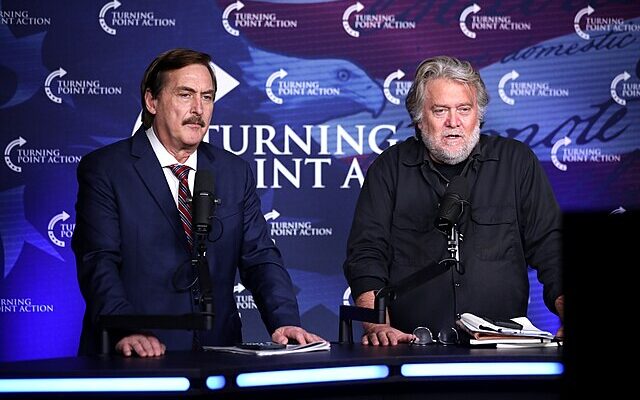
By Minnesota’s already fractious Republican primary grew even more combustible on Thursday as MyPillow founder Mike Lindell—businessman, Trump loyalist, and the nation’s most visible evangelist of election-fraud conspiracies—formally launched his bid for governor. His entry adds a combustible mix of celebrity, controversy, and intraparty risk at a moment when Republicans are still searching for a viable challenger to Democratic Gov. Tim Walz, writes The New York Times.
Lindell, who has spent the last several years promoting claims that voting machines are routinely manipulated to alter election outcomes, announced his run before a throng of supporters and a swarm of national media. His decision thrusts him into a primary already thick with established political figures: Minnesota House Speaker Lisa Demuth, former state Sen. Scott Jensen, attorney Chris Madel, and State Rep. Kristin Robbins. None has yet emerged as a clear favorite—an opening Lindell hopes to exploit.
Walz, meanwhile, seeks a third term after serving as the Democratic vice-presidential nominee in 2024. With Democrats holding the governorship since 2018, the party’s strategists are quietly satisfied with the current trajectory: a splintered GOP field and a polarizing newcomer whose national profile may energize hard-right voters while pushing moderates toward the incumbent. The governor’s allies have long argued that a fractured Republican coalition is Walz’s greatest advantage heading into 2026.
Lindell, undeterred by that logic, framed his candidacy as a revolt against what he describes as a stagnant and unresponsive state government. “I’m tired of these decisions being made by our government here in Minnesota that don’t help any of us,” he told reporters. He cast his business empire—now battered by legal costs—as proof of his executive mettle. “There’s no one else that can do as good a job as I know I can do, because I’ve had to build businesses, and it needs to be run like a business.”
He previously discussed trying to become chairman of the Republican National Committee.
His pitch carried a familiar Lindell flourish: defiant confidence bordering on siege posture. “I can face adversity, and I just think no one else can,” he said.
True to form, Lindell signaled that “election integrity” will remain a centerpiece of his message, even as he fights defamation lawsuits from voting-machine companies and navigates mounting financial pressures on MyPillow. Alongside that theme, he previewed a platform heavy on school-choice expansion, stricter immigration measures, urban crime enforcement, and addiction-recovery programs—issues designed to animate conservatives across both rural and suburban Minnesota.
He recently won a major appeal in a lawsuit over the 2020.
Yet his presence in the race raises strategic questions for Republicans. Lindell’s high wattage guarantees attention, but not necessarily broad support. His national fame stems less from Minnesota politics than from his role as the country’s most outspoken defender of claims courts have repeatedly rejected. Party leaders worry that a primary dominated by election-fraud grievances could undercut efforts to reclaim statewide credibility.
President Trump, for his part, has long celebrated Lindell’s loyalty, praising the pillow magnate for what he views as steadfastness amid criticism. The former president’s backing—should he choose to offer it explicitly—could carry significant weight in a Minnesota GOP still shaped by Trump-era populism.
From the Capitol in St. Paul, the political arithmetic is shifting by the day. Lindell’s entrance ensures a race defined as much by personality and spectacle as by policy. Whether that dynamic sharpens the Republicans’ challenge to Walz—or derails it before it begins—may determine the contours of Minnesota politics for years to come.
Walz’s campaign comes amid heightened scrutiny over a series of fraud scandals involving state social services and federal aid programs. Federal prosecutors and watchdog reports have detailed allegations that more than $1 billion in taxpayer funds was misdirected through abuse of welfare and pandemic-relief systems, prompting bipartisan concern and intensifying the political spotlight on the governor.
Republican investigators, including members of the U.S. House Oversight Committee, have launched inquiries into how the fraud occurred and whether state officials should have acted more aggressively to prevent it. In letters to Walz’s office, committee leaders cited “serious concerns about how you… allowed millions of dollars to be stolen” and sought communications related to potential delays or gaps in the state’s response.
Locally, state workers and critics have also voiced frustration with how agencies managed internal warnings about abuse and compliance failures, alleging that whistleblower complaints were sidelined and that oversight mechanisms were weakened.
Walz has publicly defended his administration’s actions, acknowledging fraud in the systems while characterizing structural issues as part of broader program vulnerabilities. Law enforcement continues to pursue criminal charges against individuals accused of exploiting social-services funds, and Minnesota’s fraud controversies remain a central campaign issue as the 2026 gubernatorial contest takes shape.
[Read More: New Dem Governor Doubles Down On Biden Scandal]