 By
By The CIA deployed a classified new technology known as Ghost Murmur to help locate and rescue a wounded U.S. airman hidden deep inside Iran after his F-15E Strike Eagle was shot down during combat operations, according to sources familiar with the mission.
The system combines long-range quantum magnetometry sensors with artificial intelligence to detect the faint electromagnetic signature of a human heartbeat and distinguish it from environmental interference. One source described the challenge as akin to “hearing a voice in a stadium, except the stadium is a thousand square miles of desert,” adding, “In the right conditions, if your heart is beating, we will find you.”
The operation marked the first known operational use of Ghost Murmur by the CIA. The technology, developed by Lockheed Martin’s Skunk Works division, had previously been tested aboard Black Hawk helicopters and is being evaluated for potential use on F-35 fighter jets.
The incident began late April 2 (U.S. time), when an Iranian missile struck a two-seat F-15E Strike Eagle, call sign Dude 44, over southern Iran. Both crew members ejected safely but landed miles apart in hostile territory. The pilot, identified as Dude 44 Alpha, was recovered relatively quickly during a daylight operation that drew intense enemy fire. The weapons systems officer, Dude 44 Bravo—a senior colonel—was injured on landing and spent nearly 48 hours evading Iranian forces.
The CIA’s “Ghost Murmur”, The Tool That Listens for a Heartbeat from Miles Away.
In early April 2026, an American F-15E Strike Eagle was shot down over Iran. The pilot was rescued quickly, but the weapons systems officer was left on his own, hiding in rugged mountain terrain… pic.twitter.com/Pdv0daTRzj
— VisionaryVoid (@VisionaryVoid) April 7, 2026
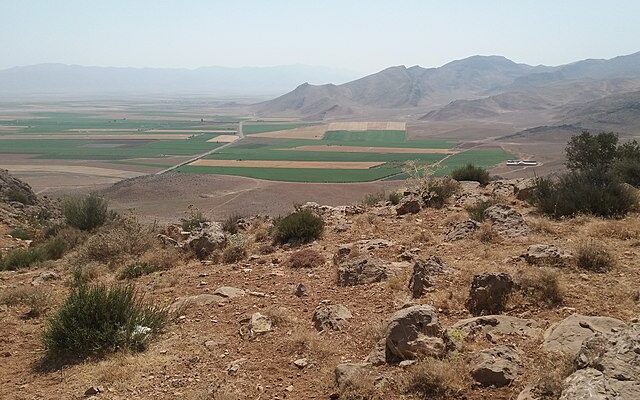
According to officials, those forces included elements of the Islamic Revolutionary Guard Corps and local militia units actively searching for the downed airman, reportedly with a bounty placed on him. The officer moved into rugged mountain terrain and concealed himself inside a crevice to avoid detection.
Although the airman activated a standard Boeing-made Combat Survivor Evader Locator beacon, the signal alone was insufficient to provide a precise location across the vast terrain. Ghost Murmur proved decisive, particularly in the low-electromagnetic-interference conditions of the remote desert and mountains, where competing signals were minimal and environmental clarity allowed for more accurate detection.
“The name is deliberate,” one source told The New York Post. “‘Murmur’ is a clinical term for a heart rhythm. ‘Ghost’ refers to finding someone who, for all practical purposes, has disappeared.” The same source described the environment as “about as clean an environment as you could ask for,” noting that the system performs best in isolated areas with limited signal clutter.
Under typical conditions, detecting a human heartbeat requires sensors placed close to the body, often in clinical settings. Advances in quantum magnetometry—using microscopic defects in synthetic diamonds—have extended that range, allowing detection from significant distances under the right conditions.
At a White House briefing Monday, President Donald Trump and CIA Director John Ratcliffe referenced the operation without disclosing technical details. Ratcliffe said the agency “achieved our primary objective by finding and providing confirmation that one of America’s best and bravest was alive and concealed in a mountain crevice—still invisible to the enemy, but not to the CIA.” He added that the confirmation was relayed to Defense Secretary Pete Hegseth and then to the president, enabling the next phase of the mission.
Trump described the rescue as one of the most complex combat search-and-rescue operations in U.S. military history, involving hundreds of personnel and, during the second phase, 155 aircraft operating at night. He said the CIA identified the airman from “40 miles away,” calling the effort “like finding a needle in a haystack,” and credited the agency’s role in coordinating the operation. The president also pointed to deception tactics used to mislead Iranian search teams.
The mission concluded without American casualties, though officials acknowledged significant risks. Helicopters involved in the rescue took small-arms fire, and two transport aircraft became immobilized and were later destroyed to prevent sensitive technology from being captured.
Officials emphasized that the downed airman’s own survival training and decision-making were critical to the outcome, allowing him to remain concealed long enough for rescuers to locate him.
Ghost Murmur is not considered a universal solution. Sources said it performs best in remote environments and requires time to process signals. In this case, it complemented rather than replaced the airman’s locator beacon, helping narrow the search area and confirm his position when he briefly emerged from cover.
Senior officials described the recovery as a demonstration of coordinated U.S. military and intelligence capabilities operating under high-risk conditions, highlighting both technological advancement and traditional search-and-rescue execution.
[Read More: University Hiding Details Of Charlie Kirk Shooting]