 By
By Iranian President Masoud Pezeshkian declared that Iran is engaged in what he described as an all-encompassing conflict with Western powers, sharply escalating rhetoric at a moment of renewed regional tension and diplomatic uncertainty.
In an interview with Iranian state media, Pezeshkian said Iran now faces coordinated pressure from multiple fronts. “In my opinion, we are at total war with the United States, Israel and Europe. They want to bring our country to its knees,” he stated, reported The Times of Israel.
The remarks come months after a brief but intense direct military confrontation between Iran and its adversaries earlier this year, noted the report. In June 2025, Israel launched airstrikes against Iranian military and nuclear facilities, an operation that was later joined by U.S. forces targeting key nuclear sites. The 12-day exchange included large-scale missile attacks from Iran and resulted in significant casualties and infrastructure damage inside the country.
Pezeshkian contrasted the current standoff with past wars, arguing that today’s conflict is more diffuse and difficult to confront. “During the war with Iraq, the situation was clear: they fired missiles, and we knew exactly where we were responding. But now, we are being surrounded from every angle,” he said.
Despite acknowledging the scale of pressure facing Iran, the president claimed the country’s military position has strengthened since the June clashes. He asserted that Iran’s armed forces have demonstrated resilience, citing improvements in both equipment and personnel readiness following the conflict.
The interview was published shortly before a scheduled meeting between U.S. President Donald Trump and Israeli Prime Minister Benjamin Netanyahu, where Iran’s nuclear program and regional activities are expected to be central topics of discussion.
Western governments have long accused Iran of seeking nuclear weapons capability, an allegation Tehran continues to reject, insisting its nuclear program is intended solely for peaceful purposes. Iran has also faced renewed sanctions and ongoing diplomatic friction, worsening economic strains tied to oil exports and domestic livelihoods.
Analysts say Pezeshkian’s forceful language signals defiance rather than de-escalation, potentially complicating any effort to revive nuclear negotiations or ease sanctions.
According to Iranian reports, Pezeshkian himself narrowly survived the fighting and suffered a leg injury in an Israeli strike during the war.
Despite the damage, Pezeshkian insisted Iran’s armed forces emerged stronger. “Our beloved military forces are doing their jobs with strength and now, in terms of equipment and manpower, despite all the problems we have, they are stronger than when they attacked,” he said. “So if they want to attack, they will naturally face a more decisive response.”
He also claimed the conflict reinforced internal cohesion rather than weakening the state, arguing that government services continued uninterrupted throughout the fighting and urging the public to avoid internal disputes that Iran’s adversaries could exploit.
Alongside security concerns, Pezeshkian acknowledged deepening economic strain driven by sanctions, declining oil revenue, and the costs of conflict. He said protecting livelihoods remains his government’s top priority.
To that end, Pezeshkian outlined a 20-point economic plan aimed at stabilizing prices for essential goods and supporting lower-income households, including expanded use of vouchers. He also called for sharp reductions in government spending, an austere national budget, and improved efficiency across state operations.
Reducing waste—particularly in water, electricity, and fuel consumption—was a recurring theme. Pezeshkian said he personally uses a desk lamp rather than lighting an entire room to conserve electricity.
According to The New York Times, the president has described Iran’s spending practices as “what crazy people do.”
In separate remarks to university students and local officials, Pezeshkian struck a notably pessimistic tone about his own ability to reverse the country’s economic decline.
“If someone can do something, by all means go for it,” he told students, according to The New York Times. “I can’t do anything; don’t curse me.”
“Why should I solve [the economic problems]?” he reportedly asked provincial governors. “You shouldn’t think that the president can make miracles happen.”
🚨نمای هوایی از تجمع گسترده مردم و اعتراضات امروز تهران/تصاویر هوایی نشاندهنده حضور پرشمار مردم در خیابانهای تهران و گسترش اعتراضات مردمی علیه فشارها و سرکوب رژیم تروریستی جمهوری اسلامی است. pic.twitter.com/X3xaH7Suw5
— LiveIranNews (@IranNewsAgency0) December 29, 2025
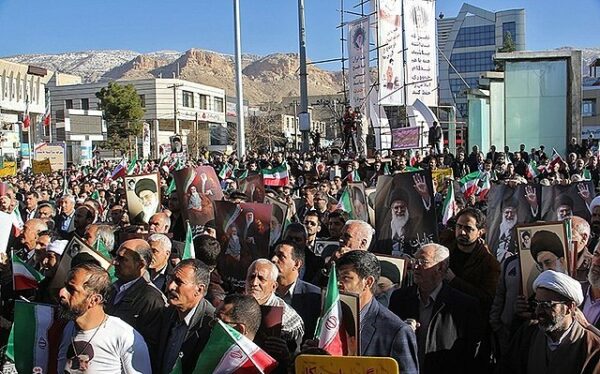
That answer has not soothed the population. Iranian traders and shopkeepers returned to the streets Monday for a second day of protests after the country’s currency slid to a new record low against the U.S. dollar, underscoring mounting economic pressure inside the Islamic Republic.
Videos circulating on social media showed hundreds of demonstrators rallying along Saadi Street in downtown Tehran and in the Shush neighborhood near the capital’s Grand Bazaar — a historic commercial hub that played a decisive role in the 1979 Islamic Revolution that toppled Iran’s monarchy and brought clerical rule to power.
Witnesses told The Associated Press that traders shuttered their shops and urged neighboring businesses to do the same, signaling coordinated resistance among merchants hit hard by the currency’s collapse. The semiofficial ILNA news agency reported that many businesses and traders halted operations, although some shops remained open despite the unrest.
BREAKING:
Protests against the Islamic regime escalate in Iran as people continue to take to the streets of Iran despite the late hour.
They are chanting pro-Shah, pro-monarchy and pro-@PahlaviReza slogans as Iran’s economy nears hyperinflation status pic.twitter.com/mirLfSkHXs
— Visegrád 24 (@visegrad24) December 28, 2025
Some of the supporters are calling for a return of the Shah
[Read More: FBI Expanding Probe In Minnesota Fraud Case]