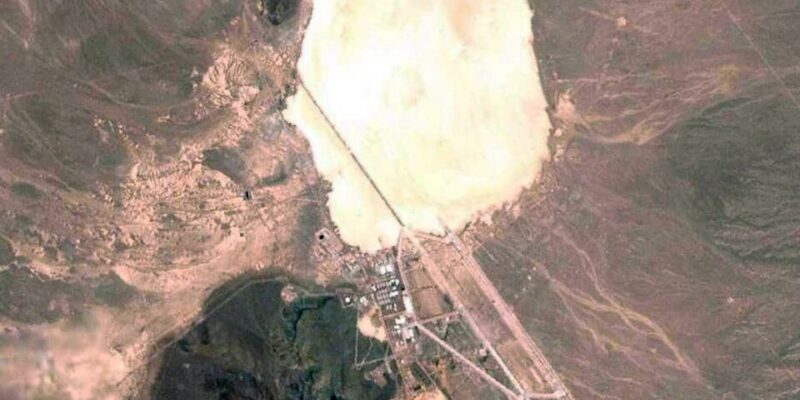
For decades, Area 51 has functioned as both a classified testing ground and a cultural magnet for speculation—an institutional site where secrecy and imagination reinforce one another. That dual identity shapes how even routine events are received. When the ground begins to move nearby, the result is not simply geological interest, but immediate interpretive expansion.
That dynamic is now visible following a brief earthquake swarm in the surrounding Nevada desert. Over a 24-hour period, at least 17 earthquakes were recorded in a remote stretch of southern Nevada, the largest measuring magnitude 4.4. The sequence began with a shallow event roughly 2.5 miles beneath the surface and continued into the early morning hours, with the latest tremor detected shortly before 5:40 a.m. local time. More than 100 individuals reported feeling the shaking. Given the area’s sparse population—primarily military personnel and contractors—no damage was immediately identified, according to The Daily Mail.
In structural terms, the episode is neither unprecedented nor especially ambiguous. The region lies within the Basin and Range Province, where the Earth’s crust is gradually extending. That process produces fault movement and, at intervals, clustered seismic activity. Earthquake swarms occur when stress redistributes along these faults, releasing energy through a sequence of smaller events rather than a single rupture.
🚨 CNN aired a segment on a disc-shaped UAP filmed by the U.S. military over the Afghanistan–Pakistan region.
The object shows no visible propulsion, no heat signature, and appears under intelligent control… and is officially classified as a UAP.
— UAP Reporting Center (@UAPReportingCnt) April 30, 2026
Interpretation, however, shifts with location. Geophysicist Stefan Burns described the site as “an unusual place to get an earthquake,” pointing to both its relative quiet compared to more active regions and the shallow depth of the initial shock. He noted that “earthquakes and underground explosions can sometimes produce similar seismic signatures, especially when energy is released suddenly beneath the surface.” While assessing the swarm as “most likely a natural earthquake,” he acknowledged “some ambiguity” and characterized the data as “worth discussing in the context of whether this is a covert underground nuclear test.”
That ambiguity—limited, technical, and typical in early-stage seismic analysis—has nonetheless expanded outward. Proximity to Area 51 ensures that even minor anomalies are reframed through the logic of secrecy. Established in 1955 and associated with classified aerospace development, the installation has accumulated a layered mythology that extends beyond its documented role in programs such as the U-2 and A-12 reconnaissance aircraft. Declassification has clarified aspects of that history without displacing the broader assumption that the site contains activity fundamentally inaccessible to public understanding.
At times, that assumption has been reinforced by official conduct. A 2025 Pentagon report indicated that Cold War-era officials deliberately encouraged certain UFO narratives to obscure sensitive weapons programs, including the circulation of fabricated imagery. The effect was not merely concealment but habituation: unexplained phenomena became more readily interpreted as extraordinary rather than classified.
The Artemis II astronauts appeared to share a subtle, telling look after Trump remarked that he spoken to pilots who said “they saw things you wouldn’t believe.”
— Tom Thompson🛸 (CORTEX ZERO) (@Cortex_Zero) April 30, 2026
Recent federal activity has added to the attention surrounding such events. In March 2026, the government registered domains including alien.gov and aliens.gov as part of its public-facing efforts on unidentified anomalous phenomena. On April 29, President Donald Trump said his administration would release as much information as possible on UFOs in the near future.
That backdrop has helped drive online speculation about the Nevada quakes. But experts say the explanation is more straightforward. The region sits in an active tectonic zone where the Earth’s crust is slowly stretching, a process that can produce clusters of shallow earthquakes like those recorded this week.

 By
By