 By
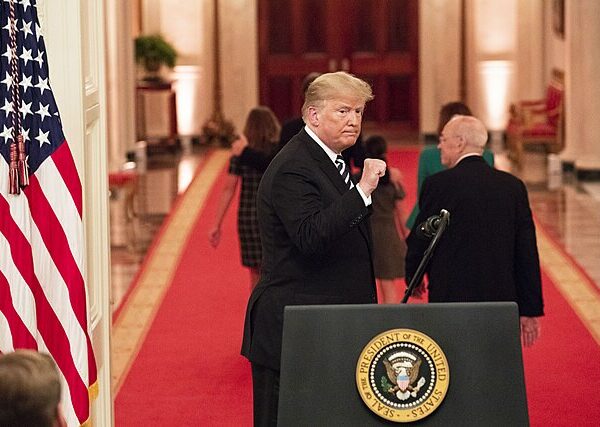
By President Donald Trump warned Thursday that the federal government could reclaim direct control of Washington, D.C., if voters elect democratic socialist Janeese Lewis George as the city’s next mayor, escalating a growing battle over the future of the nation’s capital.
Asked about the possibility of a Lewis George victory, Trump said he would not allow the District to pursue policies that drive businesses out of the city.
“I wouldn’t like it — and maybe we take back Washington, run it on the federal basis. We won’t put up with it. We’re not going to lose our businesses.”
Q: There's a crazy socialist running for mayor of Washington, D.C. What if she wins?@POTUS: "I wouldn't like it — and maybe we take back Washington, run it on the federal basis. We won't put up with it. We're not going to lose our businesses." pic.twitter.com/XDG1977D2W
— Rapid Response 47 (@RapidResponse47) June 11, 2026
The warning comes less than a week before D.C. voters head to the polls for the June 16 Democratic primary, a contest that is expected to determine the city’s next mayor in the overwhelmingly Democratic District.
Lewis George, a Ward 4 councilmember and former prosecutor, has emerged as the leading candidate to succeed Mayor Muriel Bowser, who is stepping down after three terms in office. A Washington Post-Schar School poll released in early June found Lewis George leading her chief rival, former Councilmember Kenyan McDuffie, by double digits, although roughly one-quarter of likely Democratic voters remained undecided.
The election will also mark the District’s first use of ranked-choice voting in a mayoral primary. Voters will be allowed to rank as many as five candidates in order of preference, potentially delaying the final result for several days if no candidate wins a majority in the initial count.
Lewis George is a self-described democratic socialist who has been endorsed by the Metro D.C. chapter of the Democratic Socialists of America and a coalition of labor unions and progressive groups. Her campaign has focused heavily on affordability, tenants’ rights, publicly supported housing and universal child care. She has also promised a more confrontational posture toward the Trump administration.
In a recent interview with NOTUS, Lewis George said the city was ready for a mayor who would shift power away from business interests.
“Absolutely. D.C. is ready for a mayor who shifts interests from corporate interests to people. For the last 16 years there has been a small group of wealthy insiders who have benefited from leadership in D.C. that has made decisions based on their interests and not necessarily the interests of the people of the District. And I think it’s time for the people to be the center of D.C., and not these special interest groups.”
Lewis George has proposed building 72,000 housing units over five years and imposing a new Business Activity Tax that would affect certain law firms, lobbying firms and professional partnerships that do not currently pay traditional business taxes in the District. She has argued that the measure could generate as much as $500 million in additional annual revenue while avoiding tax increases on working families and middle-class residents.
Her critics have questioned whether her agenda would further weaken the District’s business climate at a time when the city is struggling with the effects of federal workforce reductions and competition from neighboring Virginia. Bowser has stopped short of formally endorsing McDuffie but recently said she has “always supported” him and emphasized the need for the next mayor to make the city more competitive.
Trump’s statement adds a new dimension to a race that was already shaped heavily by the District’s relationship with the federal government.
Unlike a state or ordinary city, Washington operates under a limited form of self-government granted by Congress through the 1973 Home Rule Act. The law allows residents to elect a mayor and council, but Congress retains sweeping authority over the District. Article I, Section 8 of the Constitution gives Congress the power to “exercise exclusive Legislation in all Cases whatsoever” over the seat of the federal government.
Trump has previously used that authority to intervene in local affairs. In August 2025, he invoked an emergency provision of the Home Rule Act to place the Metropolitan Police Department under temporary federal control and deployed National Guard troops to the city as part of a crackdown on crime and homelessness.
The takeover, which has made the nation’s capital significantly safe, saw one of the strangest police resignations in history. The president has also led the repairs of some of the monuments across Washington, including the Reflecting Pool and Columbus monument near Union Station.
The Republican-controlled Congress has already shown a willingness to challenge D.C. policies. Because local legislation is subject to congressional review, lawmakers can overturn measures approved by the D.C. Council. Republican lawmakers have also introduced proposals in recent years that would sharply curtail or repeal home rule.
Lewis George and McDuffie have both criticized federal intervention in the city, but they have differed over how aggressively the next mayor should confront the White House. Lewis George has sought to make resistance to Trump a centerpiece of her campaign, while McDuffie has argued that public safety and economic stability must remain the city’s top priorities.
Trump’s warning ensures that the final days of the campaign will focus not only on housing costs, crime and city services, but also on a larger question hanging over the capital: how much independence Washington can exercise when the federal government decides to intervene.
[Read More: Dem Staffer Charged In Terror Plot]