 By
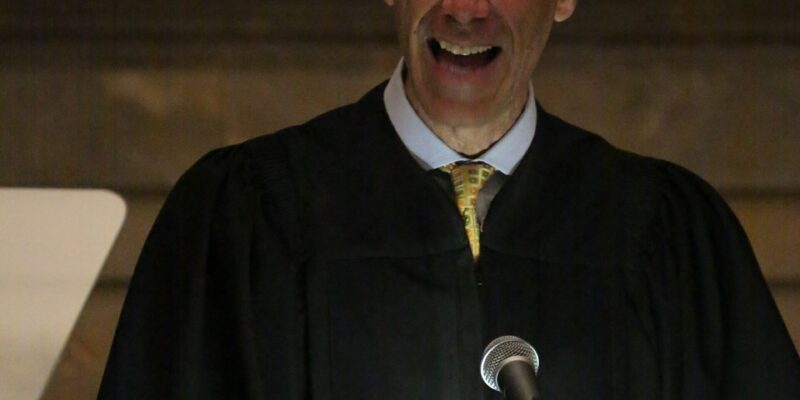
By Chief U.S. District Judge James Boasberg repeatedly hosted Chinese law students through a Washington exchange program connected to a foundation that members of Congress and U.S. intelligence officials have identified as part of Beijing’s sprawling foreign-influence apparatus, according to a bombshell investigation by Natalie Winters.
Boasberg participated nine times in the U.S.-Asia Institute’s Szymanski Rule of Law Program, according to program records highlighted Thursday by reporter Natalie Winters. Six of those appearances came while Boasberg served on the Foreign Intelligence Surveillance Court, including in 2020, when he was the secretive court’s presiding judge.
The FISA court reviews some of the federal government’s most sensitive applications for foreign-intelligence surveillance and searches.
Boasberg, an Obama appointee confirmed in 2011, served on the FISA court from 2014 to 2021 and became its presiding judge in 2020. He is now chief judge of the U.S. District Court for the District of Columbia and has emerged as a prominent figure in legal battles involving the Trump administration.
The new reporting places Boasberg inside another controversy that has received increasing scrutiny in Washington: the Chinese Communist Party’s efforts to build relationships with influential Americans through ostensibly benign academic, cultural and professional exchanges.
The U.S.-Asia Institute describes its Szymanski Rule of Law Program as an effort to bring Chinese law students to Washington to observe the American legal and political systems. The institute says participants have met with more than 140 judges as well as hundreds of members of Congress, congressional staffers and executive-branch officials. (US-Asia Institute)
Institute host records cited by Winters list Boasberg as participating every year from 2015 through 2020 and again in 2022, 2023 and 2024, identifying him as a “9X Host.” The 2020 program was conducted remotely because of the COVID-19 pandemic.
The connection attracting scrutiny is the China-United States Exchange Foundation, or CUSEF.
A 2023 recruitment flyer published by Tsinghua University Law School states: “The program is also underwritten by the China-United States Exchange Foundation.” The flyer advertised “exclusive conversations with influential actors” and proceedings “few are ever able to witness firsthand.”
USAI’s own materials separately identify CUSEF as a sponsor of the companion program that sends American law students to China.
CUSEF was founded in 2008 by Tung Chee-hwa, the former chief executive of Hong Kong who later served as a vice chairman of the Chinese People’s Political Consultative Conference. That organization occupies a central role in China’s United Front system, which U.S. officials have repeatedly warned Beijing uses to cultivate relationships and influence institutions abroad.
House Select Committee on the Chinese Communist Party Chairman John Moolenaar, R-Mich., raised those concerns directly in a November 2025 letter urging Columbia University to sever ties with CUSEF. Moolenaar described the organization as “an instrument of the CCP’s approach to political warfare, including influence operations intended to shape Americans’ views toward the People’s Republic of China (PRC) government.” His letter also cited Senate Intelligence Committee testimony describing CUSEF as “a united front-linked organization that advances Chinese Communist Party interests.”
Moolenaar warned that organizations operating through the United Front system can exploit the openness of American institutions and help the CCP “identify foreigners who the party could exploit.”
Those concerns are hardly confined to Republican lawmakers.
During his 2021 confirmation hearing to become CIA director, William Burns was questioned about the Carnegie Endowment for International Peace’s previous relationship with CUSEF. Burns said he ended the relationship after taking over Carnegie because: “We were increasingly worried about the expansion of Chinese influence operations.”
That history provides important context for the latest revelations. The concern surrounding CUSEF is not simply that it is a Chinese organization sponsoring exchange programs. Senior U.S. officials and lawmakers have explicitly identified it with a broader Chinese influence system designed to cultivate relationships inside American political, academic and civic institutions.
The Szymanski program itself has reached deeply into those institutions.
USAI says the program has arranged meetings involving more than 140 American judges. Its materials also say it has facilitated extensive exchanges involving members of Congress and congressional staff. The program was founded by J. Matthew Szymanski, a former congressional staffer who later spent years working in China before returning to the United States.
According to the materials cited by Winters, Supreme Court Justice Samuel Alito participated twice, while Brett Kavanaugh participated three times and Ketanji Brown Jackson four times while they were lower-court judges. Numerous other Washington judges have also participated.
Those facts are significant because they also put the Boasberg revelations in perspective: his participation was not unique, and the available records do not establish that Boasberg knowingly participated in a Chinese influence operation or that his judicial work was affected by the program.
They do, however, raise questions about how organizations linked by U.S. officials to Beijing’s influence apparatus gained repeated access to some of the most powerful institutions in Washington.
Winters, a White House correspondent and co-host of War Room, characterized Boasberg as “a 9-time host for a CCP-founded program run by a Chinese spy front flagged for its efforts to compromise Americans.”
The primary-source record supports a narrower conclusion: Boasberg repeatedly participated in an exchange program whose activities were at least partly associated with CUSEF, an organization that congressional and intelligence officials have tied to China’s United Front influence system.
That distinction does not eliminate the larger concern. It illustrates the method U.S. officials themselves have warned about for years: Beijing’s influence efforts often operate not through obvious espionage, but through prestigious institutions, professional exchanges and relationship-building with people occupying positions of influence.
[READ MORE: Democrat In Trouble For Fraud]