 By
By Michigan Democrats are facing mounting internal turmoil following a chaotic endorsement convention that has triggered legal challenges, exposed procedural vulnerabilities, and fueled broader questions about party discipline heading into the 2026 election cycle.
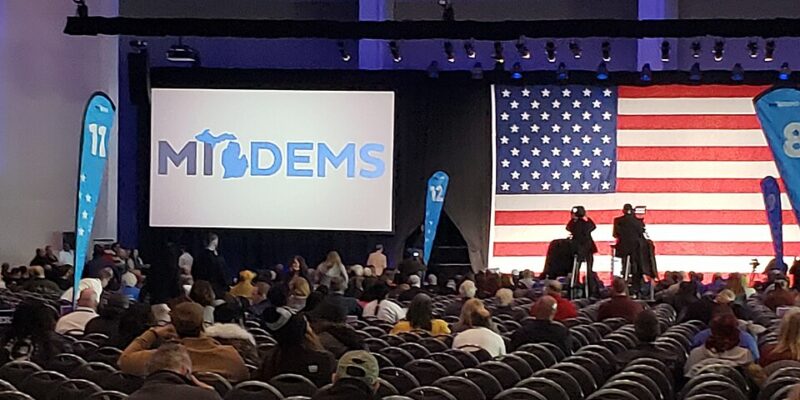
At the center of the controversy is the Michigan Democratic Party’s April 19 endorsement convention at Huntington Place, where party officials relied on a phone-based electronic voting system that critics say was easily circumvented. According to accounts from candidates and delegates, the system allowed individuals to cast votes remotely despite party rules requiring in-person participation, according to a report by The Detroit News.
The Michigan Republican Party has seized on the episode, framing it as evidence of broader dysfunction. In a statement posted on social media, the party said, “Democrats can’t even secure their own internal elections. What a mess!” The criticism reflects a broader GOP effort to portray Michigan Democrats as disorganized and divided at a moment when internal cohesion is typically critical.
🚨 BOMBSHELL REPORT: Hundreds of ineligible voters took part in the Michigan Democrat Party's endorsement convention, highlighting the importance of voter integrity.
Losing candidates are starting to take legal action against the Democrat Party, claiming the election were STOLEN… pic.twitter.com/Nqv5cFljwT
— Michigan GOP (@MIGOP) May 4, 2026
The controversy stems from the use of Election Buddy, an online platform accessed via personal devices. While delegates were required to credential in person, the system relied on a self-attestation mechanism rather than robust location verification. That gap has become the focal point of multiple complaints.
Cathy Albro, a former Democratic congressional candidate, publicly acknowledged that she left the convention early and later voted remotely from her home in northern Michigan. She confirmed that she checked a box affirming she was physically present at the venue. “If it’s easy to breach something like that, what else is possible?” Albro said, raising concerns that the issue may extend beyond isolated incidents.
Additional claims have surfaced suggesting that some votes may have been cast from outside the state or even outside the country. While those reports remain unverified, they have intensified scrutiny of the process and added urgency to calls for an audit.
One of the most significant challenges has come from the campaign of Sylvia Santana, a candidate for the Michigan State University Board of Trustees. Her team filed a 53-page appeal alleging that more than 200 votes were cast remotely, based on a review of location data. Santana lost her race by roughly 15 votes in unofficial tallies, a margin that has sharpened the stakes of the dispute.
Other high-profile endorsement contests were similarly close. Washtenaw County Prosecutor Eli Savit secured the party’s endorsement for attorney general, while Lt. Gov. Garlin Gilchrist II won the nod for secretary of state. The narrow margins in several races have raised the possibility that disputed votes could have altered outcomes, further complicating efforts to resolve the controversy.
Party officials have defended the integrity of the convention, emphasizing that delegates were required to check in on site before receiving voting credentials. Spokesman Derrick Honeyman said the party has established procedures for candidates to challenge results, with a deadline for appeals set for May 4. Party Chair Curtis Hertel has dismissed some of the allegations as “baseless attacks,” signaling resistance to claims that the process was fundamentally compromised.
Even within Democratic ranks, however, frustration is evident. Ingham County Clerk Barb Byrum, who lost her bid for the secretary of state endorsement, has called for significant reforms, including a return to paper ballots and the possibility of shifting nominations to a statewide primary system. Her proposals underscore a growing recognition that the party’s current approach may be ill-suited to maintaining confidence in close contests.
The convention dispute comes alongside other controversies that have complicated the party’s political positioning. Recent criticism of a top Democratic fundraiser over a social media post referencing a Nazi officer, as well as backlash surrounding the nomination of a candidate accused of praising Hezbollah after the ousting of a Jewish regent, have contributed to a perception of internal disarray.
Michigan trial attorney and Democratic fundraiser Kelly Neumann, the co-chairwoman of Senate candidate Mallory McMorrow’s campaign, threatened the Free Beacon with “legal action” unless we retract our story about her Veterans Day Facebook post honoring her grandfather who served… pic.twitter.com/uodkzPtqOi
— Washington Free Beacon (@FreeBeacon) May 4, 2026
While Democratic leaders have sought to contain the fallout through procedural defenses and appeals mechanisms, the cumulative effect has been to amplify doubts about governance within the party itself, and it couldn’t come at a worse time. A recent poll showed Republican Mike Rogers leading the current Democratic frontrunner in the upcoming race for Senate, a race that Democrats desperately need to win if they have any hopes at retaking the Senate.
🚨BREAKING: Republicans' odds to flipping the Michigan US Senate seat JUMP OVERNIGHT.
Michigan – 2026 US Senate
🟥Mike Rogers 44.3% (+3.7)
🟦Abdul El-Sayed 40.6%Polling average via https://t.co/9Ii8o7yuqi.
Abdul El-Sayed has become the Democratic frontrunner, and compared to… pic.twitter.com/719k9gKjvt
— Election Time (@ElectionTime_) May 3, 2026
For Republicans, the moment presents a strategic opportunity. By contrasting the Democratic incompetence across the state the 2026 election as a choice between order and dysfunction.
[Read More: Democratic Candidate Threatens Fetterman, Trump, With Violence]