

 By
By For decades, liberals have told Americans that “fair” redistricting means engineering the House of Representatives until it produces something close to partisan symmetry. But that is not fairness. It is managed politics by another name, all to benefit the Democrats. A genuinely fair map would not begin with the desired partisan outcome and then work backward. It would begin with geography, population, compactness, contiguity, county lines, municipal boundaries, and recognizable communities—and then let the voters who actually live in those places determine the result.
That is what makes a recent AI redistricting experiment so revealing, noted Ace of Spades, which created a map on the alleged principles liberal tout. According to the analysis, when congressional districts are drawn according to neutral, traditional criteria—compact shapes, respect for communities, equal population, and minimal political manipulation—the result is not a perfectly balanced House.
It is a House in which Republicans would likely hold a durable majority.
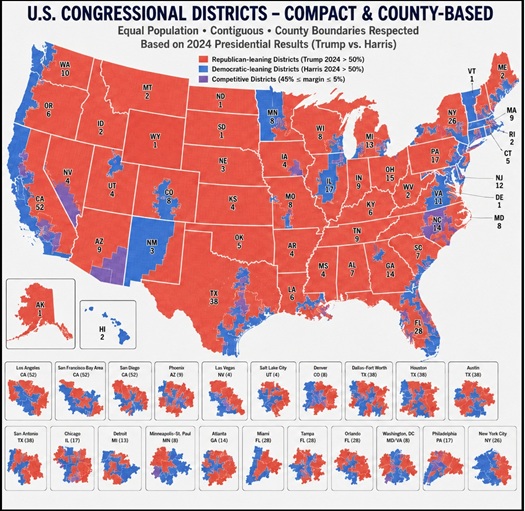
Ace of Spades also broke down the districts by state. Republicans would start with roughly 241 seats to the Democrats having 194.
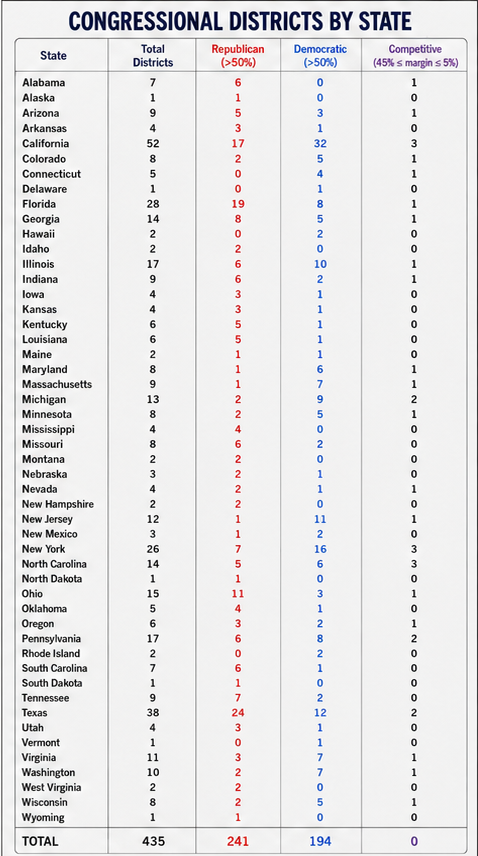
This should not be surprising. The basic geography of American politics has changed. Democratic voters are now heavily concentrated in dense urban centers, while Republican voters are spread more evenly across rural, exurban, and many suburban communities. A map that treats geography seriously will therefore not produce the same outcome as a map that treats geography as an obstacle to partisan equity. It will show the country as it is: politically sorted, unevenly distributed, and deeply shaped by where people choose to live.
The AI exercise attempted to generate a national congressional map based on rules that reformers routinely claim to support. Districts should be compact. They should be contiguous. They should avoid bizarre, sprawling shapes. They should keep counties, cities, and neighborhoods together where possible. They should not crack communities apart or pack voters into districts for the purpose of manufacturing a preconceived partisan result, just like Democrats say they want.
Except, they don’t: the map would be dominated by Republicans if they followed their principles rather than what they actually do in states like Illinois and Maryland.
That’s something worth remembering next time you see Democrats bemoaning gerrymandering in Republicans states.
[Read More: Netanyahu Plans To Dramatically Change Israel-American Relationship]