 By
By Two of North America’s leading Islamic scholarly organizations have opened a potentially significant new source of political money, ruling that American Muslims may use a portion of their obligatory religious charity to influence elections and public policy.
The Fiqh Council of North America and the Assembly of Muslim Jurists of America’s Resident Fatwa Committee jointly approved the ruling on Jan. 30. The guidance came in response to a question asking whether zakat — one of the central religious obligations in Islam — could be used to support politicians or campaigns in an effort to change American policy toward Gaza.
Their answer was yes.
“[G]iving one’s zakat for influencing political causes is warranted.”
The ruling is notable because zakat has traditionally been associated primarily with assistance to the poor and needy. The Quran identifies eight categories of eligible recipients, however, and the councils relied on one known as al-mu’allafah qulūbuhum, generally translated as “those whose hearts are to be reconciled.”
Historically, Islamic jurists applied that category to people whose goodwill could benefit or protect the Muslim community, including non-Muslim political leaders. The new fatwa extends that reasoning to modern American politics, arguing that Muslims living as a minority in a non-Muslim country may use zakat to influence public officials when doing so would protect Muslim interests or advance causes important to the broader Muslim community.
The ruling specifically points to Gaza and the influence of political lobbying in the United States. It says Muslim communities should develop institutions and lobbying organizations capable of using zakat money to pursue political objectives, provided those groups are transparent, accountable and compliant with campaign-finance law.
There are limits. The scholars say individuals should not simply choose candidates and give them zakat directly. Money should instead be distributed through reputable organizations with scholarly and professional oversight. The political cause must directly benefit the Muslim community, there must be reasonable grounds to believe the expenditure will work, and the councils advise Muslims against directing most of their zakat toward politics.
The fatwa suggests that perhaps no more than one-eighth of a donor’s zakat should go toward such activity, although it describes that figure as a suggestion rather than a binding religious rule. Aid to the poor and hungry, the scholars stress, should remain zakat’s primary purpose.
Even that fraction could represent substantial political money if widely adopted. RealClearInvestigations reported this week that the ruling could make more than $140 million a year in Muslim charitable giving available for political activity.
The change comes as Muslim political organizations have become increasingly ambitious about electing candidates across the United States — and as several of those networks have begun playing a larger role in Democratic politics.
That has been particularly visible in Michigan.
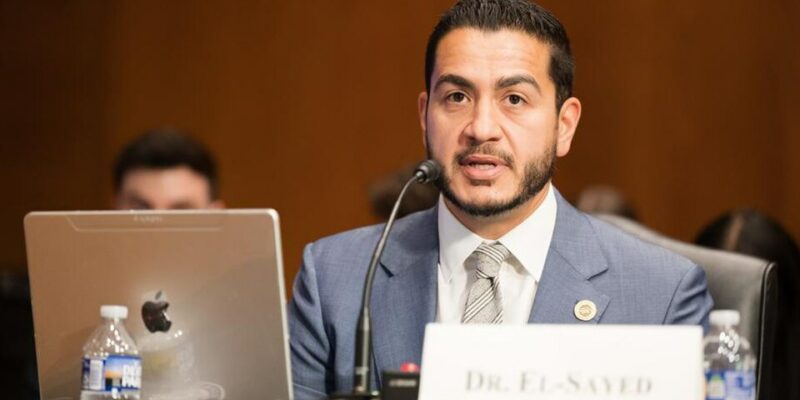
As New Conservative Post previously reported, Democratic Senate nominee Abdul El-Sayed received significant assistance from Fighting for Michigan, a super PAC supported in part by his father-in-law, Tayeb Jukaku. Jukaku contributed $200,000 to the PAC and previously served as president of the Michigan chapter of the Council on American-Islamic Relations. He remains on its board.
Jukaku has also served on the founding committee of the Islamic Society of North America. Both CAIR and ISNA were named as unindicted co-conspirators in the federal Holy Land Foundation terrorism-financing prosecution. Federal prosecutors said ISNA was among organizations that “are and/or were members of the US Muslim Brotherhood” and identified CAIR as part of the Brotherhood’s Palestine Committee or its organizations. Neither group was convicted in the case, and designation as an unindicted co-conspirator does not establish criminal wrongdoing.
Those connections received renewed attention after El-Sayed narrowly defeated Rep. Haley Stevens in Michigan’s Democratic Senate primary. A website identifying itself as the Muslim Brotherhood’s official outlet celebrated his victory, portraying the result as a defeat for supporters of Israel and praising El-Sayed’s opposition to unconditional American military assistance to the Jewish state.
The fatwa could give political networks operating in the same space another fundraising tool.