 By
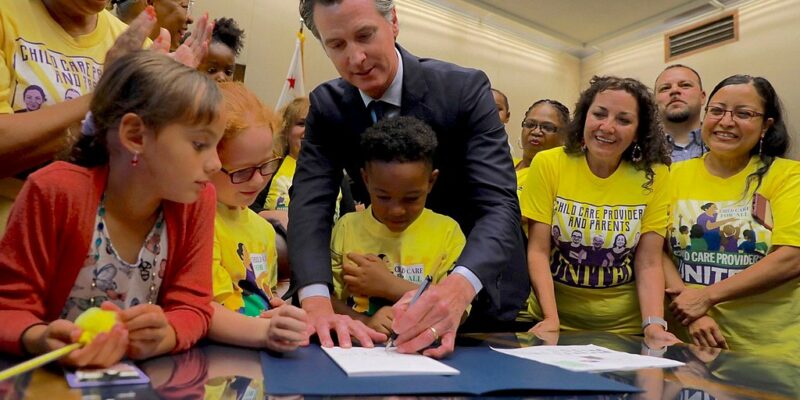
By Democrats are intent on never leaving people alone. They want politics everywhere: on the basketball courts, during movies, and in schools. California Gov. Gavin Newsom has apparently decided there are still a few corners of American life that are not political enough.
His solution: family group chats.
Newsom’s political operation is recruiting supporters to inject Democratic talking points into private conversations, alumni Facebook groups and other online spaces that typically have little to do with politics.
And according to Newsom’s own team, that is precisely the point, writes The New York Post.
“A lot of those spaces aren’t political at all,” an email from Newsom’s Campaign for Democracy PAC told supporters. “That’s the point.”
The new program will train volunteers to become what the PAC calls “Messengers,” teaching them how to take political material provided by Newsom’s organization and work it naturally into conversations with friends, family members and colleagues.
“So the task isn’t forwarding talking points or propaganda,” the email says. “It’s taking what we send you and translating it for people you understand better than we do.”
It continues: “The person already in that room is the only one who can get a message in, and the only one who knows how to say it so it doesn’t feel out of place.”
In other words, the political message works precisely because it does not look like a political message.
The effort provides another example of a recurring Democratic organizing strategy: taking political advocacy beyond campaigns, advertisements and rallies and inserting it into the supposedly apolitical parts of everyday American life.
Your neighborhood Facebook page. Your college alumni group. Your friends’ text thread. Your family group chat.
Nothing needs to remain outside politics.
The strategy is not entirely new.
More than a decade ago, Barack Obama’s political operation famously tried something similar around Thanksgiving.
In November 2013, Organizing for Action — the nonprofit created from the remains of Obama’s 2012 reelection campaign — launched a campaign called “Health Care for the Holidays,” encouraging supporters to use holiday gatherings to persuade uninsured relatives to sign up for Obamacare.
The organization even offered advice for initiating those conversations with family members. Contemporary coverage described the campaign as an attempt to bring the Affordable Care Act directly into Thanksgiving and other family gatherings.
White Dudes For Harris makes Obama's "pajama boy" look like the Marlboro Man. pic.twitter.com/kFDLRjJO1r
— Andrew Wilkow (@WilkowMajority) July 30, 2024
The Obama White House soon took the idea directly to millennials.
At a December 2013 White House Youth Summit attended by 160 people between the ages of 18 and 35, Obama urged young activists to spread the Obamacare message among people they personally knew.
“For your friends and your family, the most important source of information is not going to be me, it’s going to be you,” Obama told them.
The White House account of the event said the young attendees met with administration officials and activists to discuss “spreading the word about the Affordable Care Act and organizing to get people enrolled in their respective communities.” Obama also encouraged them to post on Facebook, Instagram and Twitter.
Newsom’s new program is essentially the updated, algorithm-era version of that strategy.
Instead of sending millennials home with Obamacare talking points for Thanksgiving, Newsom’s PAC wants volunteers equipped with campaign-approved material and trained to slip it into the digital rooms where their friends and relatives already gather.
Los Angeles political consultant Matthew Klink criticized the program for exactly that reason.
“The left has this preoccupation of making everything political and this is carrying it to another extreme,” Klink told the California Post. “We joke that families are already divided by talking politics at the dinner table — this is that on steroids.”
Newsom’s office sees it differently.
“The governor is using his national grassroots operation for one purpose: helping Democrats win,” spokesman Izzy Gardon said in an email. “This cycle alone, he has already raised more than $5.4 million from small donors for Democratic candidates and organizations across the country. Now he’s expanding that effort by mobilizing digital volunteers to organize in the battleground races that will determine whether the Mad King — Donald Trump — has unchecked power or faces a democratic majority that will stop him.”
Gardon added: “This is smart political organizing: empowering real people to persuade the people they know best.”
And politically speaking, that is exactly what it is.
Campaign strategists have understood for generations that voters are often more receptive to information from people they know than from politicians or advertisements. Newsom’s operation is attempting to systematically harness that trust.
But the revealing part is where his organization wants those conversations to happen.
The PAC is specifically targeting spaces that “aren’t political at all.”
Newsom’s volunteers will receive Democratic messaging through a web application called Echo and disseminate it through their personal networks. The effort will include eight weeks of Tuesday training sessions.
The program arrives as Newsom aggressively expands his national political organization ahead of a possible 2028 presidential campaign.
He is traveling to Michigan this weekend after progressive Democrat Abdul El-Sayed won the state’s Democratic Senate primary. Newsom is expected to campaign with candidates around the state, attend fundraisers, meet with Black community and faith leaders, speak with students and organized labor, and participate in Democratic organizing events.
Newsom has also emerged as a major national Democratic fundraiser, directing money toward state parties and candidates in presidential battlegrounds including Michigan, Nevada, New Hampshire and South Carolina. Axios reported this week that Newsom has helped raise money for 14 state Democratic parties as he builds an increasingly national organization.
Meanwhile, Newsom and his wife, Jennifer Siebel Newsom, are connected to ongoing federal investigations. Newsom has accused the Trump administration of politically targeting his family, while reporting indicates multiple investigations were underway and at least one concerns his wife’s finances. Newsom has denied wrongdoing. His PAC raised roughly $250,000 in the two weeks after he publicly announced the investigation in June.
Newsom continues to avoid formally declaring himself a presidential candidate.
His political infrastructure, however, continues to look increasingly presidential.
And now that infrastructure is coming to a group chat near you.
The larger lesson may be more important than Newsom’s presidential ambitions.
For modern Democratic organizers, political persuasion no longer needs to stay within the traditional boundaries of politics. The family dinner became an Obamacare enrollment opportunity under Obama. Now the family text chain can become a Democratic messaging operation under Newsom.
The fact that these spaces are not political is no longer a reason to leave them alone.
As Newsom’s own PAC put it: “That’s the point.”
[READ MORE: Investigation Shows Pentagon Connections To China]