 By
By Vice President JD Vance has spent much of President Donald Trump’s second term occupying an unusually favorable position in Republican politics. He is the sitting vice president, a popular figure among the party’s conservative base, and the most obvious candidate to inherit the political movement Trump has built over the past decade.
But Trump, according to The New York Times, has never been inclined to surrender control of the Republican Party’s future and now appears far less certain that Vance is ready to take the reins.
The president has repeatedly posed a pointed question to aides and political allies: “Does JD Vance have what it takes to go all the way?” His answer, according to people familiar with the conversations, is often less than reassuring. Trump is not convinced.
The doubts have introduced a layer of tension into a relationship that is more complicated than its public presentation suggests. Trump has given Vance significant responsibilities, drawn him into major administration decisions, and elevated his national profile. He has even compared Vance to Eliot Ness for his work investigating fraud.
Yet Trump has also repeatedly returned to what he sees as the vice president’s political vulnerabilities. He has told allies that Vance has never won a difficult election without his help, a reference to the decisive role Trump’s endorsement played in the crowded 2022 Ohio Republican Senate primary. He has questioned the number of vacations Vance has taken as vice president and contrasted them with his own work habits.
Trump has also repeatedly revisited Vance’s initial reservations about the war with Iran, an issue that has placed the vice president in an increasingly uncomfortable political position. At one point, Trump made the comparison directly to Vance: “I’m more of a peace person than you are — but I had to do it.”
The criticism has extended beyond policy. Trump has fixated on Vance’s presentation, his footwear, and his tendency to interject during conversations. He has also returned more than once to the moment in April 2025 when Vance, an Ohio State graduate, fumbled the university’s national football championship trophy during a White House ceremony on the South Lawn. Trump has reportedly told people that he was glad the mishap did not happen to him.
In November, the president reportedly wondered aloud why Vance was not more subservient, contrasting him unfavorably with officials who work for Chinese President Xi Jinping.
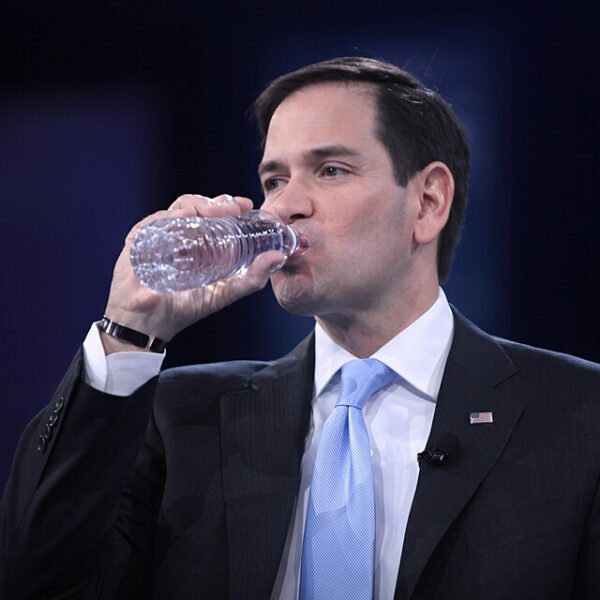
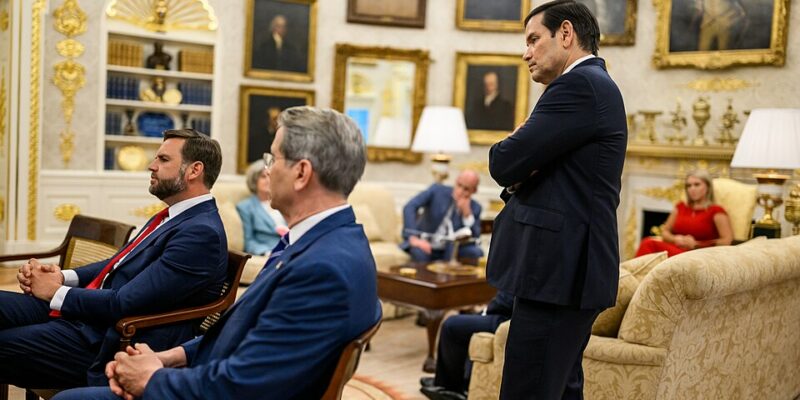
The dynamic has become more consequential as Secretary of State Marco Rubio has emerged as an increasingly plausible rival for the Republican nomination in 2028. Trump publicly described Vance last August as the “most likely” heir to his political movement. But he has also praised Rubio extensively, spent substantial time with him aboard Air Force One and during weekends in Florida, and increasingly treated the succession question as unsettled.
At a Rose Garden dinner earlier this month, Trump openly tested the room. “Who likes JD Vance?” he asked. “Who likes Marco Rubio?” He then made clear that the informal contest did not amount to an endorsement of either man.
The uncertainty is reflected in the polling. An Emerson College survey released Thursday found Vance leading Rubio by only a single percentage point among likely Republican primary voters, 36 percent to 35 percent. Vance had held a commanding 52 percent share in Emerson surveys conducted in August and February. Rubio, by contrast, has climbed sharply from 9 percent last August and 20 percent in February.
New – 2028 presidential poll
🔴 Vance 36% (-16)
🔴 Rubio 35% (+15)
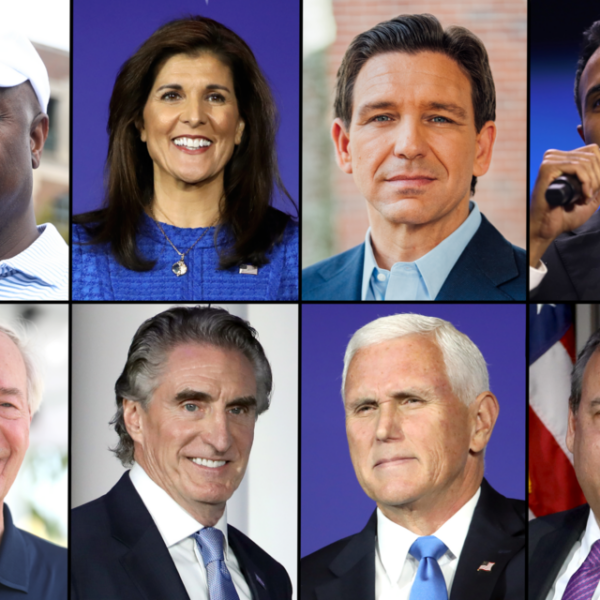
🔴 DeSantis 5%
🔴 Haley 5%Emerson #A – LV – 5/25 pic.twitter.com/eldW5wztGY
— Political Polls (@PpollingNumbers) May 28, 2026
The Secretary of State also released a video earlier in the month that raised eyebrows.
— Marco Rubio (@marcorubio) May 6, 2026
The shift does not mean Vance has lost his frontrunner status. But it does suggest that the Republican succession contest has become more fluid than it appeared only months ago.
In an interview with Fortune, Trump emphasized the stakes without naming a preferred successor. “Whoever gets this is going to be very important. And if you get the wrong person: disaster.”
Vance’s political predicament has been sharpened by the war with Iran. Before joining the administration, he built a substantial portion of his political identity around skepticism of extended American military involvement overseas. He has since defended Trump’s decision to go to war, even as some of his earlier supporters argue that the conflict represents a departure from the foreign policy message that helped Trump reshape the Republican Party.
Vance has also defended the administration’s proposed $1.8 billion fund to compensate people who claim they were subjected to political persecution by the federal government. The fund has drawn scrutiny from critics who argue that it could be used to reward Trump allies. A federal judge temporarily blocked the administration from setting up or operating the fund on Friday while legal challenges proceed.
Kentucky Gov. Andy Beshear, a potential Democratic presidential contender in 2028, has sought to turn the controversy into a broader indictment of Vance’s political identity.
Beshear accused the vice president of “governing in a way that only hurts the places he claims he was from” and said Vance had abandoned the populist image that helped propel his rise. “JD Vance doesn’t have a real bone in his body. Last week he’s appointed the fraud czar, and this week he’s defending a new $1.7 billion slush fund for the Trump administration to give to their allies.”
Questions about Vance’s political effectiveness have also followed him into state-level battles. Last summer, the White House political operation dispatched the vice president to Indiana in an effort to persuade Republican lawmakers to redraw the state’s congressional districts. The legislators refused, prompting Trump to launch a campaign of retribution against Republicans who resisted the administration’s pressure.
State Representative Ed Clere, a nine-term Republican who voted against redistricting, pointed to another international setback when assessing Vance’s influence. “He came up empty in Indiana the same way that he came up empty in Hungary.”
Clere has since announced a plan to retire from the General Assembly after facing a primary threat that saw many of his colleagues defeated.
The remark referred to Vance’s campaign intervention on behalf of Hungarian Prime Minister Viktor Orban, who lost his reelection bid in April after 16 years in power.
Despite those setbacks, Vance retains important advantages. A Pew Research Center survey released in February found that 75 percent of Republicans and Republican-leaning independents viewed him favorably. His position as finance chair of the Republican National Committee also gives him access to major donors and an institutional foothold that few prospective candidates could easily match.
Vance remains the presumed Republican frontrunner. But his status is no longer uncontested, and his future depends heavily on the approval of a president whose support has always been conditional, personal, and subject to sudden change.
[Read More: Washington Nationals Executive Fired For Anti-Catholic Bias]