 By
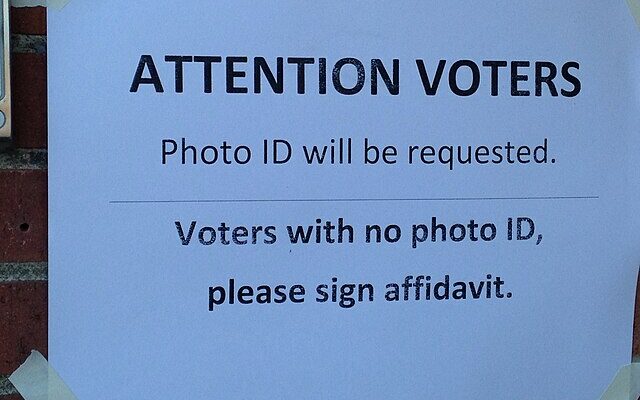
By Another federal judge has stepped in to stop the Trump administration from enforcing a basic election-integrity safeguard: requiring people registering to vote to prove they are U.S. citizens.
Chief U.S. District Judge Denise Casper, an Obama appointee, on Wednesday made permanent a previous injunction blocking most of President Donald Trump’s first executive order on elections. The order would have required documentary proof of citizenship for voter registration, stopped states from counting mail ballots that arrive after Election Day, and threatened certain federal funds for states that refused to comply.
Casper sided with Democratic state attorneys general who argued Trump exceeded his authority by trying to impose the changes without Congress.
“The Constitution does not grant the President any specific powers over elections,” Casper wrote.
That is the formal legal theory. The practical effect is simpler: the administration cannot require proof of citizenship on the front end before someone gets onto the voter rolls.
The ruling came just one day after another federal judge blocked a separate Trump effort to help states check whether noncitizens were registered to vote.
As New Conservative Post reported Tuesday, U.S. District Judge Sparkle L. Sooknanan, a Biden appointee in Washington, D.C., stopped the Department of Homeland Security from allowing states to use an expanded version of the Systematic Alien Verification for Entitlements database, known as SAVE. The system was intended to help states compare voter rolls against federal immigration and Social Security data to identify possible noncitizens.
In other words, one judge blocked a proof-of-citizenship requirement for voter registration. Another blocked a database tool states could use after the fact to clean voter rolls.
Election-integrity advocates see the one-two punch as part of a broader judicial campaign against basic citizenship verification. Democrats and left-wing voting groups, meanwhile, argue the Trump administration is trying to federalize elections, intimidate voters, and purge eligible Americans from the rolls.
The Trump administration has argued that the principle should not be complicated. Only U.S. citizens may vote in federal elections, and states should have workable tools to confirm that everyone on the rolls is eligible.
Casper rejected the administration’s argument that the lawsuit was premature because the policies had not yet been implemented. She concluded that the executive order infringed on authority the Constitution gives to states and Congress, not the president.
The ruling adds to a growing list of legal defeats for Trump’s election orders. A federal judge in Washington had already blocked the administration from adding a proof-of-citizenship requirement to the federal voter registration form and from requiring military personnel to provide such documentation when registering or requesting ballots.
With the courts closing the executive route, Trump has turned to Congress. The SAVE America Act, which would impose national voter ID and proof-of-citizenship rules, passed the House but remains stuck in the Senate, where Republicans do not have the 60 votes needed to break the filibuster.
Trump responded Wednesday by turning up the pressure. He canceled a planned signing of a bipartisan housing bill and said he would not move forward until Congress passes the SAVE America Act.
That leaves the fight right where the left wants it: tied up in court, stalled in the Senate, and governed by a system that asks people to swear they are citizens but often resists letting officials verify it.
For Trump and his allies, the issue is election integrity. For the judges blocking him, the issue is separation of powers, privacy, and voting access. For voters watching the pattern unfold, the result is unmistakable: the federal courts are again making it harder to prove that only citizens are voting in American elections.
[Read More: Judge Tries To Help Illegal Voters]