








News

Health Officials Monitor U.S. Passengers After Hantavirus Outbreak on Expedition Ship

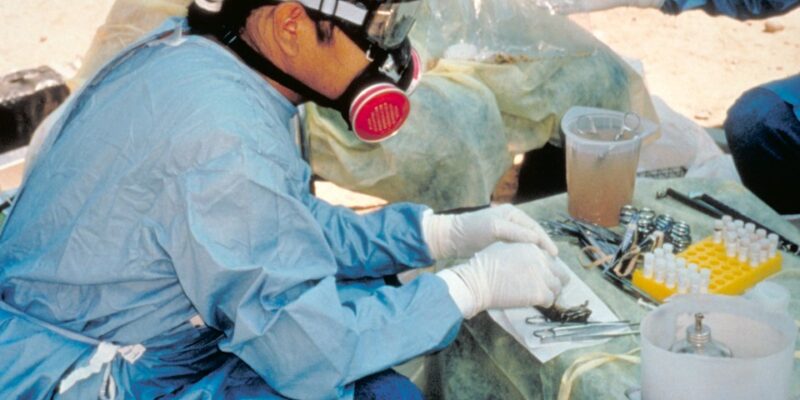
[CDC/ Cheryl Tryon, Public domain, via Wikimedia Commons]

State health officials in Texas and Virginia are monitoring three Americans who recently returned from a Dutch expedition cruise ship linked to a deadly hantavirus outbreak, as international authorities work to trace passengers who may have been exposed.

The two Texas residents and one Virginia resident had sailed aboard the MV Hondius, an Oceanwide Expeditions vessel that departed Ushuaia, Argentina, on April 1 for a polar voyage that included Antarctica and remote South Atlantic islands. All three Americans left the ship before officials publicly confirmed the outbreak. Health authorities said they remain asymptomatic and have not reported close contact with anyone who appeared sick.

The Texas Department of State Health Services said the two Texans are self-monitoring, including taking their temperatures daily and reporting any symptoms to public health officials. Virginia health officials said the state resident under observation is also in good health and has shown no signs of infection, according to The Daily Mail.

Hantavirus symptoms can take one to eight weeks to appear after exposure. Health officials say the virus is typically associated with rodent exposure and is not spread through casual contact such as brief conversations or handshakes. Person-to-person transmission generally requires close and prolonged contact, and officials say no asymptomatic transmission has been documented.

The U.S. monitoring effort has widened in recent days. Authorities in Arizona, California, and Georgia were already tracking other American passengers who had been aboard the ship, while Canadian officials are monitoring three people there. The Centers for Disease Control and Prevention and the State Department are coordinating with state and international health agencies to contact passengers and assess possible exposure.

The outbreak first drew attention after a 70-year-old Dutch man died aboard the ship on April 11. His wife died two days later, and a German national has also died in connection with the voyage. Investigators suspect the Dutch couple may have been exposed during a bird-watching trip near a garbage dump in Ushuaia, where rodents can pose a risk. The couple had traveled through southern Argentina, Chile, and Uruguay before boarding the ship.

Six Americans left the MV Hondius on April 24 at St. Helena, and more passengers disembarked before the outbreak was publicly identified on May 2. Oceanwide Expeditions later said roughly 30 passengers had left the vessel at St. Helena. The ship, carrying remaining passengers and crew under isolation protocols, is now headed toward Spain’s Canary Islands.

The World Health Organization has reported eight cases tied to the vessel, including three confirmed infections and five suspected cases, along with three deaths. Two seriously ill passengers were evacuated for treatment in the Netherlands, while another evacuee who was not showing symptoms was also receiving medical care there. Spanish officials said the ship, carrying nearly 150 people, was expected to reach Tenerife within days and that those still aboard were not presenting symptoms.

The outbreak also drew attention on Wall Street. Moderna shares rose sharply Thursday as investors reacted to renewed interest in vaccine research tied to hantavirus. An international team of scientists from the University of Bath, the United States, and South Africa is working on a possible hantavirus vaccine, though the origin of the cruise ship outbreak remains unclear. Moderna’s stock was also lifted by the publication of positive Phase 3 results in the New England Journal of Medicine for mRNA-1010, the company’s seasonal flu vaccine candidate for adults 50 and older.

For now, public health officials continue to describe the risk to the general public as extremely low. Their guidance remains focused on contact tracing, monitoring travelers who may have been exposed, avoiding rodent habitats, and seeking prompt medical care for respiratory symptoms following a possible exposure.

You may also like

More in:News

Comments are closed.